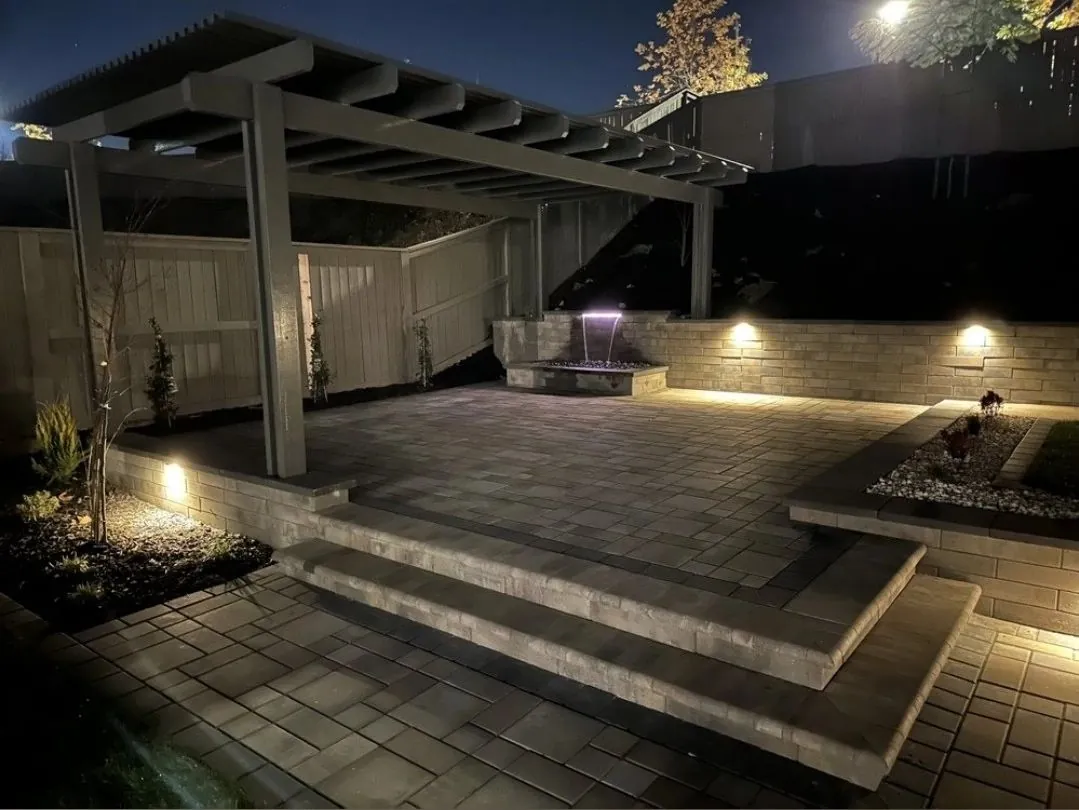
Verify the license before you look at the photos
Anyone can assemble a good-looking portfolio. Photos show what a crew can do on its best day; a license check tells you whether the company is set up to stand behind the work years later. Start at the California State License Board and look the contractor up by name or license number. You are confirming four things: the license is active, it carries the right classification for your scope, the bond is on file, and there are no unresolved disciplinary actions.
Classification matters. A C-27 Landscaping license covers landscape construction, while concrete, pools, and low-voltage electrical each have their own classifications, and a general B license covers projects combining multiple trades. Ask who is actually performing each portion of the job and under whose license. Then ask for current certificates of general liability and workers' compensation insurance, sent directly by the insurance agent rather than handed over as a photocopy. If someone is injured on an uninsured job in your backyard, that exposure can land on your homeowner's policy.
Ask what happens below the surface
The difference between a patio that looks the same in ten years and one that ripples, settles, and separates is almost entirely invisible once the job is finished. Our soils make that especially true. Much of the Sacramento Valley and the lower foothills sits on expansive clay that swells when saturated in January and shrinks hard by August. Higher up in Loomis, Auburn, and El Dorado Hills, decomposed granite and rock drain well but grade unpredictably.
So ask specific questions and listen for specific answers. How deep is the aggregate base under my pavers or concrete, and how is it compacted? Where does water go once it hits this new surface, and where does it go in a heavy December storm? A contractor who talks fluently about compacting in lifts, positive drainage away from the foundation, and a plan for downspouts and low spots has solved these problems before. One who redirects the conversation to paver colors has told you something too.
Read the proposal like the contract it is
Line-item detail is the clearest signal of whether a bid was estimated or guessed. Two proposals with the same bottom line can describe wildly different jobs, and the vague one is almost always the one that grows mid-project. Look for these in writing before you sign:
- Specific quantities and materials: square footage, paver name and size, base depth, wall block type and height, not just "patio" next to a price.
- A written list of exclusions, so demolition, hauling, or irrigation repairs do not reappear later as surprises.
- A payment schedule tied to completed phases. California limits the down payment on a home improvement contract to $1,000 or 10 percent of the contract price, whichever is less.
- A defined change order process: what triggers one, how it is priced, and confirmation that it gets signed before that work begins.
- Named allowances for anything not yet selected, such as plant material, lighting fixtures, or natural stone.
- Who pulls permits and prepares HOA submittals, and how those approval timelines affect the schedule.
Red flags worth walking away from
Most bad outcomes announce themselves during the sales process, well before construction starts.
- A price dramatically below every other bid. Something has been left out, and it is usually base, drainage, or compaction.
- Pressure to sign today for a discount that expires tomorrow.
- A request for a large cash deposit, or payment made out to an individual instead of the company.
- No physical address, no license number printed on the contract, or a license held by someone other than the person you are dealing with.
- Reluctance to let you visit a current jobsite while work is underway.
- A one-page proposal for a project that will take six weeks to build.
Judge the process, not the pitch
The strongest predictor of how a project will go is how organized the company is before anyone touches a shovel. Ask to see a real design package: a scaled plan, elevations or a 3D view, a materials list, and a phasing plan if you intend to build over time. Ask who your point of contact is during construction, and what the warranty covers, and how a warranty call actually gets handled.
Then ask for two references. One from a project finished in the last few months, and one from a project that is three or four years old. The recent call tells you about communication, scheduling, and how clean the site stayed. The older call tells you what the drainage and base work were actually worth. Standing on a four-year-old patio in person is worth more than a hundred portfolio photos.
Reliable Landscaping & Design is licensed with the CSLB (#1101544) and builds throughout Roseville, Granite Bay, Loomis, Rocklin, Lincoln, El Dorado Hills, Cameron Park, Folsom, Orangevale, Fair Oaks, Citrus Heights, and Auburn. If you are comparing bids and want a detailed, line-item proposal to measure them against, request a consultation and we will walk the property with you.