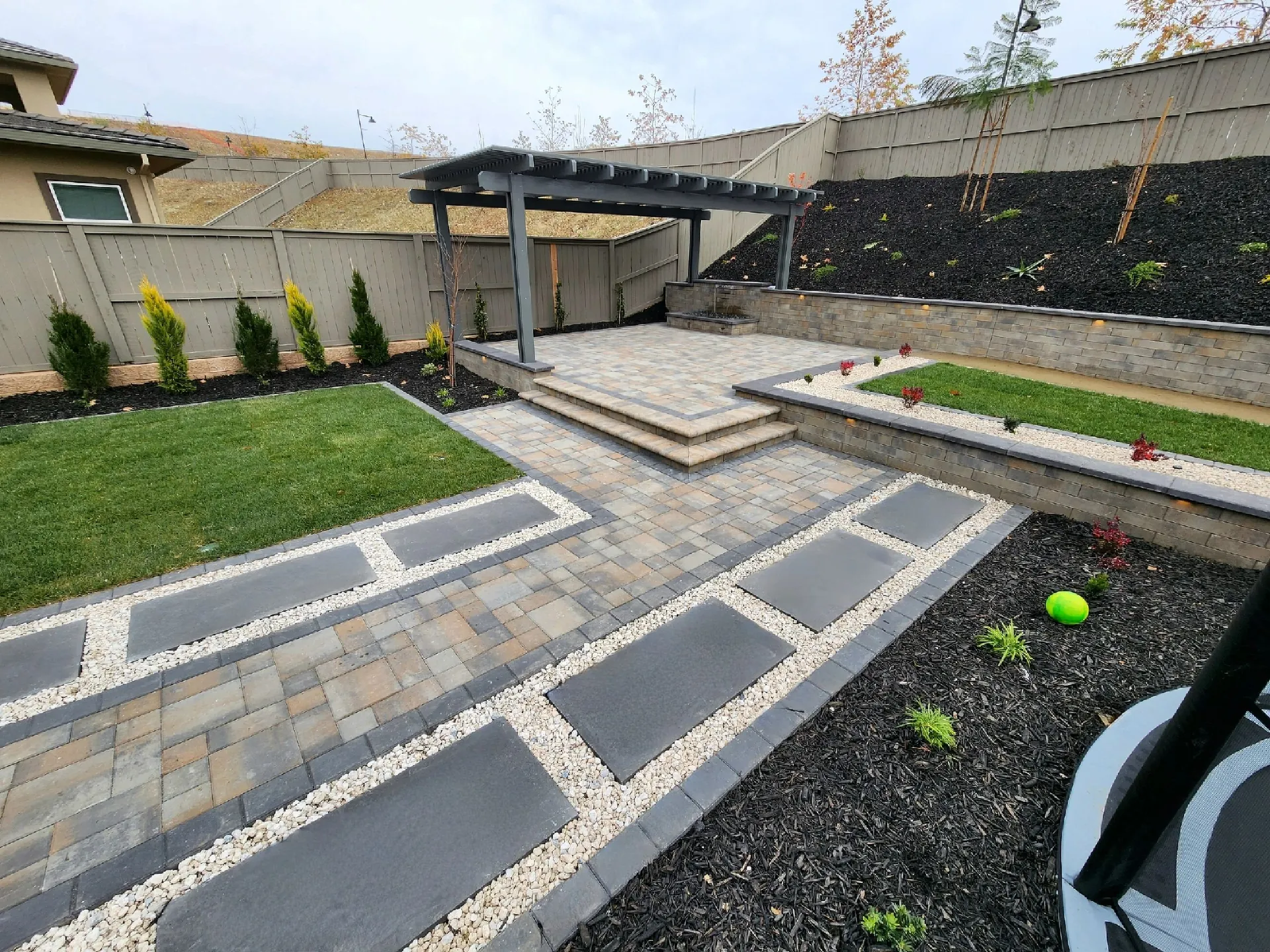
The Best Drainage Survey Happens in the Rain
Most drainage problems are invisible in October. The yard looks fine, the pavers look level, and the lawn is dry. Then the first real storm arrives and water shows you exactly where the grading, the downspouts, and the soil were never set up to handle it.
That makes the rainy season the most honest inspection your property will get. The goal is not to panic at a puddle. It is to watch where water starts, where it travels, and where it stops, so the fix addresses the cause rather than the symptom.
Why Our Soils Make Winter Harder
Across Roseville, Rocklin, Citrus Heights, and much of the valley floor, landscapes sit on dense clay. Clay absorbs water slowly, and once it is saturated it behaves almost like pavement. In the foothills around Granite Bay, Loomis, Auburn, and El Dorado Hills, a thin layer of topsoil often rests on hardpan, decomposed granite, or rock, which stops water a foot or two down and pushes it sideways.
Both conditions mean the same thing in a long storm: surface water has to be managed, because the ground will not simply take it. Slopes add speed, and speed is what carries away mulch, soil, and eventually the base under walls and paving.
Walk the Property During a Storm
Put on a jacket and spend twenty minutes outside during steady rain. Take photos or a short video of anything you see; it is far more useful to a contractor than a description from memory in July.
- Water pooling against the foundation or running toward the house instead of away from it.
- Downspouts discharging onto the ground right at the wall, or splashing onto a patio that slopes back toward the house.
- Standing water on the lawn or in beds that is still there a day or more after the rain stops.
- Muddy streaks, exposed roots, or bare soil fanning out below a slope or at the edge of a hardscape.
- Sheets of water crossing a patio, spilling over a wall cap, or leaving through a gate onto a neighbor's lot.
- Catch basins overflowing while their outlet pipe downstream stays dry, which points to a blockage in between.
Downspouts: The Cheapest Place to Start
A roof collects an enormous amount of water and delivers it to a handful of points. If those points empty at the foundation, even a well-graded yard will struggle. Splash blocks help a little on a flat lot, but on clay they mostly relocate the puddle a few feet.
The durable fix is solid, smooth-wall pipe that carries roof water underground to a safe discharge point: a curb outlet where the city allows it, a vegetated swale, or a properly sized dry well where the soil and slope support one. Solid pipe matters. Roof water belongs in a closed line, not a perforated one that leaks it back into the soil beside the house. Every line also needs cleanouts and enough fall to keep leaves and grit moving.
French Drains, Swales, and Grading
A French drain is a perforated pipe set in a gravel trench wrapped in filter fabric. It collects groundwater and saturated-soil seepage and carries it away. It works well behind retaining walls, along the uphill side of a house on a sloped lot, and in beds that stay soggy. It is not a substitute for grading, and it will not keep up with surface sheet flow on its own.
Grading is the first line of defense. Soil should fall away from the foundation, typically at least six inches over the first ten feet where the site allows, and paving should shed water toward a drain or planting area rather than toward walls. On larger lots, a shallow vegetated swale or a rock-lined dry creek can carry surface water across the yard, slow it down, and let some of it soak in. The right answer is usually a combination, sized to the roof area, the slope, and where the water can legally go.
Erosion Control on Slopes, and When to Call a Pro
On foothill slopes, keep soil covered. Bare ground erodes quickly, so mulch, jute netting, and deep-rooted groundcovers or natives do real work. Break up long runs of water with terraces or low walls, and never let a pipe discharge onto the face of an unprotected slope, where it will carve a channel in a single season.
Some signs call for professional help rather than a weekend fix: water entering a crawlspace or garage, a retaining wall that is leaning or weeping mud, pavers that sink after every storm, or recurring water crossing a property line. Those usually trace back to grading or base problems below the surface, and patching the top layer only buys time.
If this winter shows you water going somewhere it should not, Reliable Landscaping & Design (CSLB #1101544) can help. We design and build drainage, grading, and hardscape that are planned from the ground down for properties across Roseville, Granite Bay, Folsom, El Dorado Hills, Orangevale, Fair Oaks, and the greater Sacramento area. Request a consultation, bring your storm photos, and we will walk the site with you and map where the water should really go.