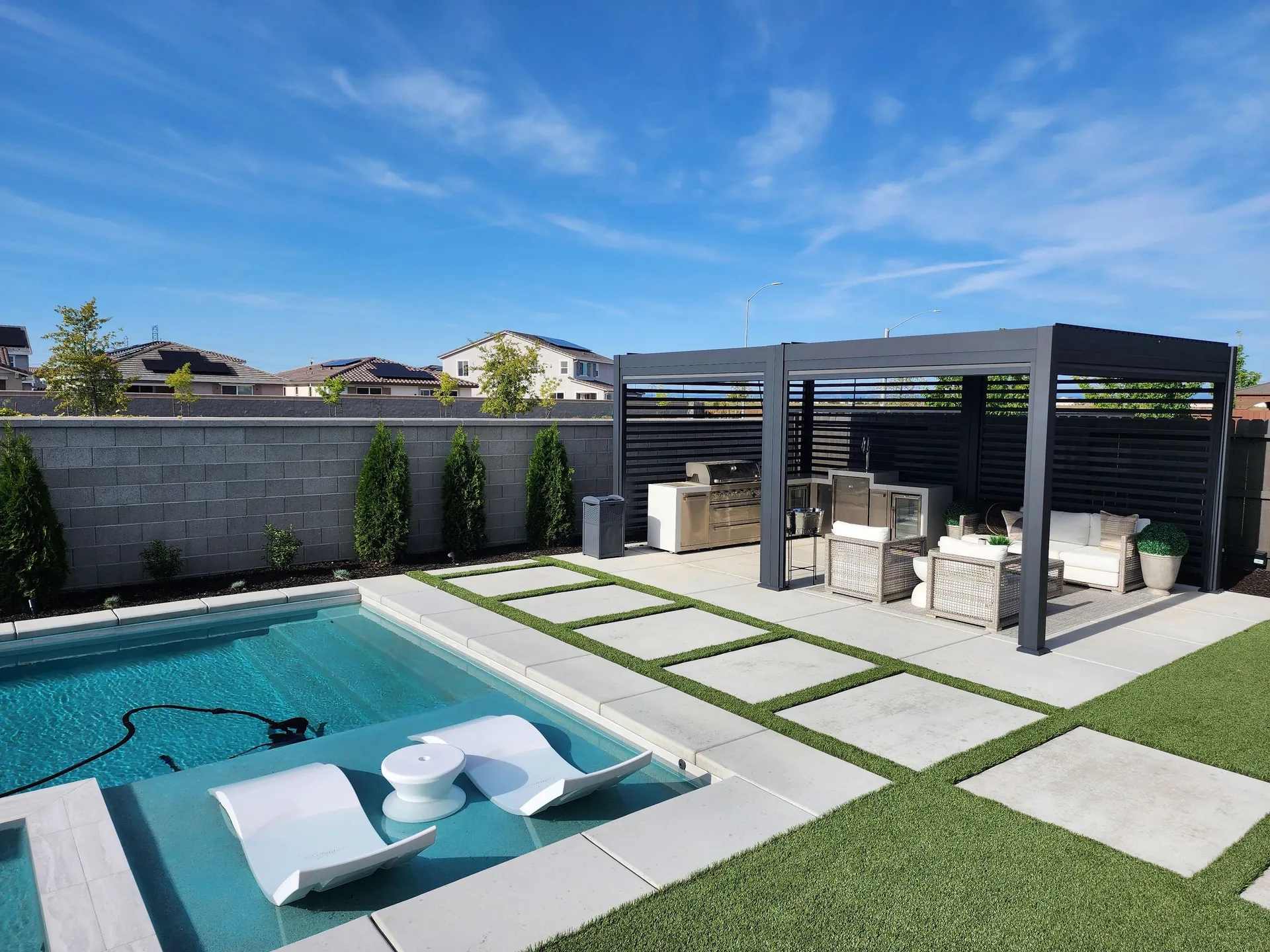
Turf Is a Base Job With Grass on Top
Almost every failed turf installation we get called out to look at failed for the same reason: someone treated it like flooring instead of like hardscape. The turf itself is the last two hours of a multi-day job. Everything that determines whether it still looks right in year ten happens before the roll ever comes off the truck.
That matters more here than in most parts of the country. Much of Roseville, Rocklin, and the east Sacramento County suburbs sits on heavy clay that swells when it takes on water and shrinks hard when it dries out. A synthetic lawn laid over untreated native soil is sitting on a surface that moves seasonally. It will telegraph every bit of that movement as low spots, ripples, and seams that open up.
Building a Base That Holds in Clay Soil
A proper turf base is closer to what goes under a paver patio than what goes under a rug. We strip the existing sod and topsoil down several inches, cut the subgrade to a deliberate slope, and build back up with crushed aggregate that gets compacted in lifts rather than dumped all at once and rolled over. Compacting in shallow layers is the difference between a base that stays put and one that settles unevenly the first wet winter.
The finish layer matters too. A screeded layer of finer decomposed granite or a similar fines material gives you the flat, dense plane the turf actually sits on. Skip that step and every stone in the base eventually reads through the backing underfoot.
- Excavation deep enough to hold real base material, not a token scrape
- Positive slope built into the subgrade so water has somewhere to go
- Aggregate compacted in lifts with a plate compactor or roller
- A screeded fines layer for a true, flat setting surface
- Weed barrier and treated perimeter before any turf goes down
Drainage Is Not Optional Here
Turf backing is perforated, so water passes through it. That is exactly why the base underneath has to be permeable and pitched. If the aggregate is choked with fines, or the pad was built dead flat against a foundation or fence line, the water stops at the clay and sits. In November and December that shows up as a soft, spongy lawn that holds a footprint.
On a yard that already collects water, turf alone does not fix it and will usually make it more obvious. That is where a drain line, a catch basin at the low corner, or rerouting a downspout away from the turf field goes in first, as part of the same job. Getting the water off the pad is what keeps the base intact underneath.
Dogs, Odor, and Infill
If dogs will use the yard, say so during design, because it changes the build. Standard silica sand infill absorbs liquid and holds it, which is where the smell homeowners complain about actually comes from. Coated or antimicrobial infills shed it instead, and they cost more for a reason.
Pet installations also want a more open, free-draining base and, on smaller runs where the dog concentrates in one spot, a drainage layer under the pad. Nothing eliminates rinsing entirely, but a yard built for pets from the start rinses clean in a few minutes. One built as a generic lawn never quite does.
Choosing a Product That Survives Our Summers
Synthetic turf in full sun gets meaningfully hotter underfoot than the air temperature, and no product on the market is exempt from that. What you can control is where you put it and what you buy. Turf under a pergola, on the shaded north side, or broken up with paver bands and planting is far more usable in August than a wall-to-wall field of it in open sun.
On product, the specification sheet tells you more than the showroom sample does.
- Face weight: heavier piles stand up longer under traffic
- Fiber shape and a mix of blade colors with a brown thatch layer for a natural read
- UV stability, and a warranty that specifically covers fade
- Pile height matched to use, since very tall piles lie down in high-traffic paths
- Backing type, especially if the yard is a pet run
Seams, Edges, and What to Expect Long Term
The visible tells of a rushed install are all at the perimeter. Seams should run with the grain in the same direction across the whole yard, be pulled tight, and be joined on seam tape rather than butted and hoped for. Edges need to be anchored to something real, whether that is bender board, a concrete or paver border, or nails driven into a base that will actually hold them. Turf that is simply tucked against a fence pulls loose within a couple of seasons.
Built properly, a synthetic lawn is a long-term surface that asks very little: a periodic brush against the grain in traffic lanes, an occasional rinse, keeping leaf litter off it so the fines do not clog. Built poorly, it becomes an expensive removal job, because the turf usually has to come out for the base to be corrected. If you are weighing turf for a yard in Roseville, Granite Bay, Folsom, or anywhere else across the Sacramento area, we are glad to walk the property, look at how water moves through it, and give you a straight assessment before anything is ordered. Reach out to request a consultation.