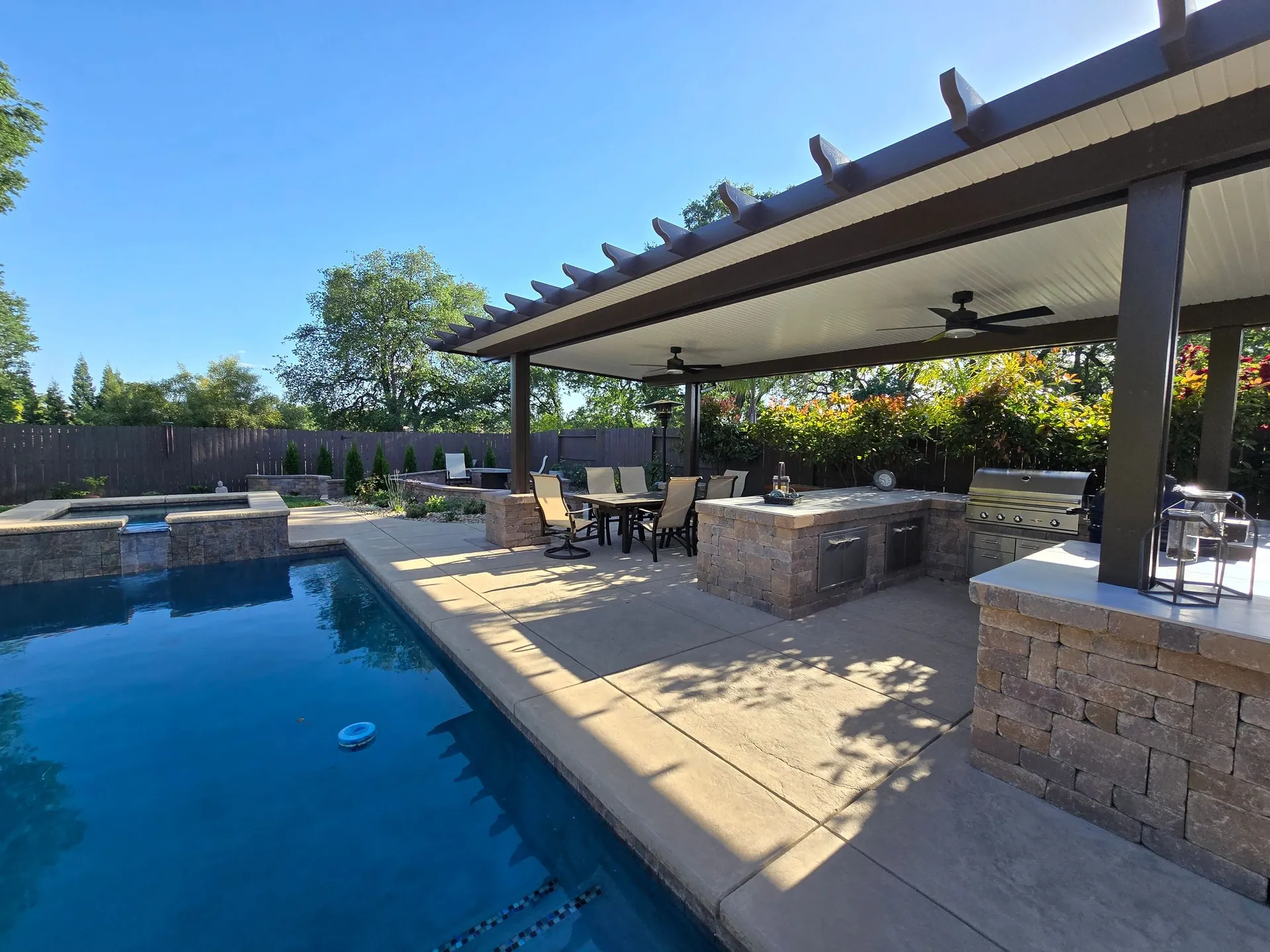
Two ways to buy a landscape project
Most homeowners don't realize they're choosing a process, not just a contractor. In the traditional path, you hire a landscape architect or designer to produce a plan, then take that plan out to bid with installation contractors. Two separate companies, two separate contracts, two separate fee structures. In design-build, one licensed contractor carries the project from the first sketch through the final walkthrough under a single agreement.
Both can produce a good yard. The difference shows up in the seams between phases, where money and weeks tend to leak out. When the person who drew the plan never has to build it, the drawing can specify things that are expensive or impractical to construct. When the crew that builds it never sat in on the design, they interpret the plan on the fly. Design-build closes that gap by keeping design and construction under the same roof and the same liability.
Single accountability when something goes wrong
The most practical advantage of design-build is that there is no one to point fingers at but the contractor you hired. In a split arrangement, if a patio drains toward the house, the installer says they built it to the plan and the designer says the installer didn't follow the spec. You're caught in the middle, paying to mediate a dispute between two parties you hired separately.
Under one contract, that finger-pointing has nowhere to go. The same company that engineered the grades is the company that poured the concrete, so a drainage failure is unambiguously theirs to fix. For a Sacramento-area yard built on the expansive clay common across Roseville, Citrus Heights, and much of Placer County, that clarity matters, because soil that swells when wet and shrinks when dry is unforgiving of grading and base-prep shortcuts. You want one number to call when the rains come.
Single accountability also changes the relationship before anything goes wrong. A contractor who knows they alone own the outcome has every incentive to flag a problem on the plan rather than build it and bill the fix later. There's no upstream party to blame and no separate installer to absorb the consequences, which tends to surface the hard conversations, about budget, about a detail that won't work, early, when they're cheap to resolve, instead of mid-construction when they aren't.
Cost predictability and fewer change orders
Change orders are where landscape budgets quietly balloon. They usually trace back to something the plan didn't anticipate: a utility line the design ignored, a material that wasn't priced until purchasing, a detail that looked fine on paper but needed a structural fix in the field. In the traditional model, the designer isn't responsible for the construction budget, so the plan can sail past these issues and leave them for the installer to discover and bill.
Design-build pulls pricing forward. Because the builder is in the room while the design is taking shape, costs are tested against reality as decisions are made rather than after the contract is signed. The estimate reflects what it actually takes to construct the plan on your specific site, including demolition, base preparation, and drainage that a design-only fee often leaves vague.
This does not make a project cheaper by default, and any contractor who promises that is overselling. What it buys you is a number you can trust and far fewer mid-project surprises. When changes do happen, they tend to be choices you're making, not corrections the contractor is making to keep the project standing.
A shorter, more controllable timeline
The traditional sequence is linear by design: finish the drawings, then bid, then negotiate, then build. Each handoff adds calendar time, and the bidding round alone can stretch for weeks while you collect and compare proposals that are rarely apples-to-apples. If the lowest bid comes back over budget, you loop back to the designer to value-engineer the plan and start the cycle again.
Design-build compresses that. Because design and pricing move together, the project can break ground sooner, and the same team can begin site prep or order long-lead materials while finish details are still being refined. In our climate that sequencing is worth real money. The dependable spring and fall windows are short, summer afternoons routinely sit in the 95 to 105°F range that slows crews and stresses fresh plantings, and winter rains can shut down grading and concrete work for days at a stretch. A process that wastes fewer weeks in handoffs is more likely to land your project inside a good weather window.
When the traditional route still makes sense
Design-build isn't automatically the right answer. If you already have a landscape architect you trust, or you want fully independent, competitively bid drawings before committing to any builder, the traditional path gives you that separation. Some homeowners simply prefer to own the plan outright and shop it around, and that's a legitimate choice.
For most everyday backyard projects, though, the value of a single accountable party, an honest budget, and a tighter timeline outweighs the appeal of separation. The method you choose is a decision worth making deliberately, before you fall in love with a rendering. If you're weighing options for a project in Roseville, Folsom, Fair Oaks, or anywhere across the greater Sacramento and Placer area, we're happy to walk you through how a design-build engagement would work on your site and where it would and wouldn't save you money.