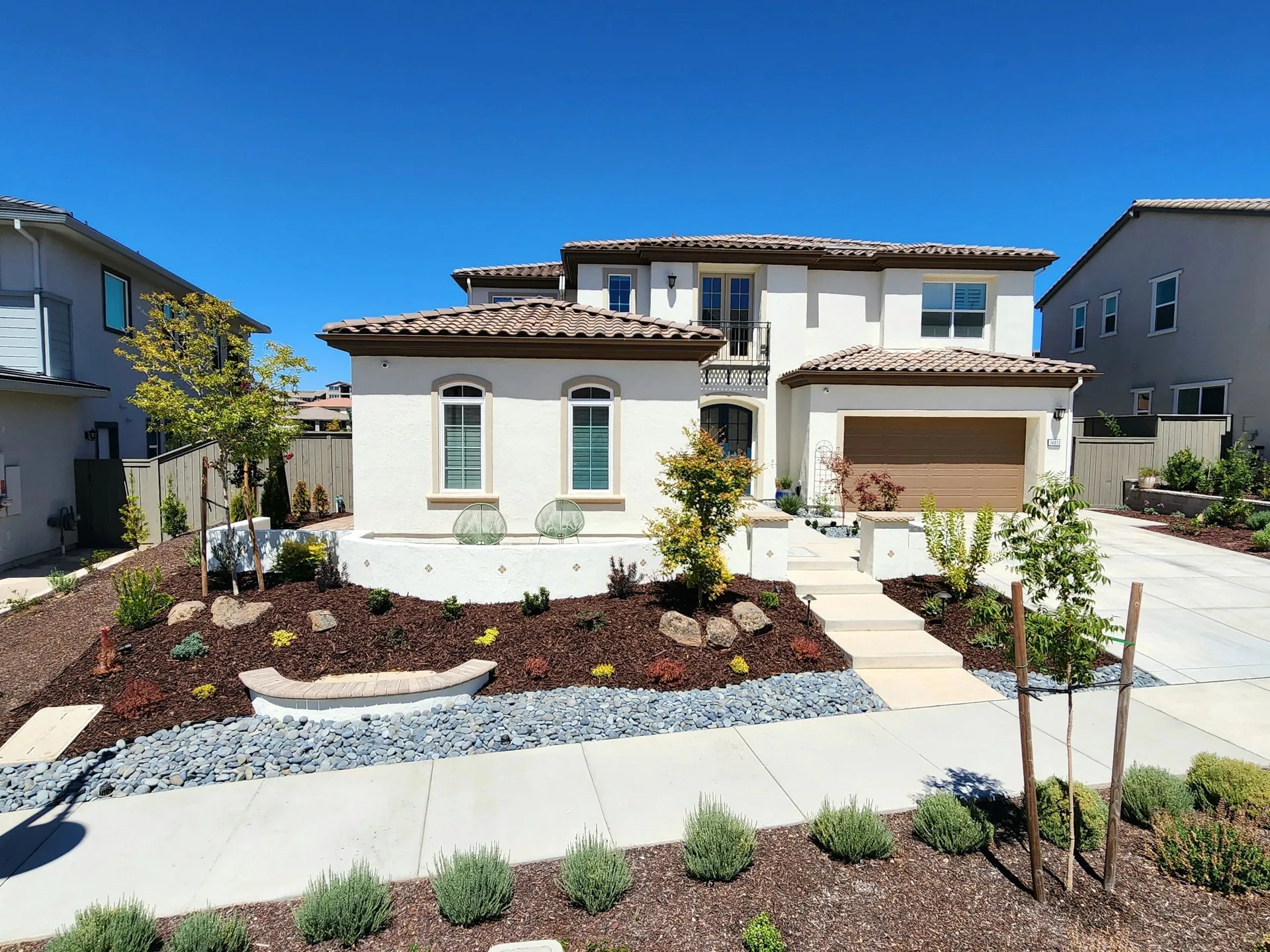
The water math on a large Placer County lot
On an acre-plus property in Granite Bay, irrigation is usually the single largest line on the summer water bill. Our region runs roughly six rainless months a year, with July and August routinely sitting above 95°F and pushing past 100°F for stretches. A conventional cool-season lawn in that climate wants somewhere on the order of 45 to 55 inches of applied water a year to stay green — far more than the sky provides.
That's why a thoughtful water-wise design tends to pay for itself, especially on estate-scale lots where the irrigated area is large. The goal isn't to strip the landscape down to rock. It's to spend your water where it earns the most — a focused lawn panel, the entertaining zone, a few specimen trees — and switch everything else to planting that thrives on a fraction of the input.
Placer County Water Agency (PCWA) and SMUD both periodically offer turf-replacement and efficient-irrigation rebates; programs and dollar amounts change year to year, so it's worth confirming current terms before you design around them. Either way, the long-run savings come from the design, not the rebate.
What MWELO actually requires on a remodel
California's Model Water Efficient Landscape Ordinance (MWELO) governs new and substantially renovated landscapes above certain square-footage thresholds, and most permitted estate projects in Placer County fall under it. In practice it caps how much of your landscape water budget you're allowed to apply, limits high-water turf areas, and requires efficient irrigation with proper hydrozoning — grouping plants by water need so a thirsty bed and a drought-tolerant one aren't on the same valve.
For homeowners this is less of a constraint than it sounds. A well-hydrozoned plan is simply a better-built plan: it waters accurately, wastes less, and keeps plants healthier. The compliance paperwork — a landscape documentation package and an irrigation audit at the end — is straightforward when the design is done right from the start, and far more painful when retrofitted onto a system that ignored it.
A Mediterranean palette built for clay and heat
The Sacramento foothills share a climate with the Mediterranean basin: wet, mild winters and long, dry summers. That's the secret to a water-wise landscape that still reads as lush rather than sparse — lean on plants evolved for exactly these conditions. The trick on our heavy clay soils is matching the planting to the drainage, because many drought-tolerant species rot if their roots sit in saturated clay through a wet January.
A premium low-water palette here is layered, not flat. Structural evergreens and ornamental grasses give year-round form, flowering perennials carry color through the dry months, and a few well-placed specimens anchor the composition. Done well, it has more texture and seasonal movement than a flat green lawn ever did.
- Structure: olive (fruitless varieties), manzanita, Western redbud, and coast live oak where space allows
- Mid-layer: rosemary, germander, Cleveland sage, lavender, and rockrose
- Movement and color: deer grass, Mexican feather grass, Salvia 'Bee's Bliss', and yarrow
- Accents: agave and other architectural succulents for focal points, set in fast-draining soil
Irrigation and mulch: where the savings really live
Plant choice gets the attention, but the irrigation system is where a water-wise landscape succeeds or fails. Inline drip emitters deliver water directly to root zones with very little evaporation loss, which matters when afternoon temperatures are in the triple digits. A smart, weather-based controller adjusts run times to actual evapotranspiration instead of a fixed schedule, so the system backs off in spring and ramps up in a heat wave without anyone touching it.
Just as important is mulch. A two-to-three-inch layer of bark or arbor mulch over planting beds slows evaporation, moderates soil temperature, and suppresses weeds. Decomposed granite works the same way on pathways and informal seating areas — it reads as refined, drains freely, and needs no water at all. Together, efficient drip and generous mulch routinely cut a bed's water demand well below what spray heads on the same plants would use.
One detail that gets overlooked on clay-soil properties is the soil prep itself. Our native ground is dense and slow-draining, and dropping low-water plants straight into unamended clay is a common way to lose them over the first wet winter. Loosening the planting area, blending in compost to open up the structure, and grading beds so water moves rather than pools gives drought-tolerant roots the air and drainage they need. The water savings only materialize if the plants actually survive to maturity.
Turf alternatives and the lawn you actually keep
Most estate water-wise renovations don't eliminate the lawn so much as relocate the idea of it. A compact panel of real grass near the house — sized for how it's used, not wrapped around the whole property — can stay, while the broad expanses convert to planting, decomposed granite, or low-water groundcover. For the panel that remains, deep-rooting, regionally appropriate grass watered deeply and infrequently uses far less than the daily-sprinkle habit most systems default to.
Where a green surface is wanted but real lawn isn't worth the water, low-growing groundcovers like creeping thyme, dymondia, or yarrow give a soft, walkable texture on a fraction of the irrigation, and quality artificial turf is a reasonable option in heavy play or pet zones. The estate look comes from how these pieces are composed — clean edges, generous beds, a clear hierarchy — not from sheer acres of mown grass.
Keeping the estate feel intact
The fear most homeowners voice is that water-wise design will make a high-end property look like a roadside median. It won't, if the design respects the same principles any good estate landscape follows: strong lines, a clear hierarchy of spaces, quality materials, and restraint. A compact, beautifully maintained lawn panel framed by deep, layered planting beds often looks more intentional than a sprawling lawn that demands constant water and mowing.
If you're weighing a water-wise renovation for a Granite Bay, Loomis, or Roseville property, the most useful first step is a site walk to map sun, slope, soil, and how you actually use the yard. From there we can model where to concentrate water, which areas convert cleanly to low-water planting, and how any current PCWA or SMUD rebate might offset the work. Reach out to start that conversation.