The trends that last solve a local problem
Plenty of outdoor design trends are just style cycles that look dated in five years. The ones worth investing in around Sacramento and Placer County have something in common: they answer a real condition of building here — long triple-digit summers, wildfire smoke that can close the yard for days, a six-month dry season, and foothill fire risk. The features below have staying power because they make a property more usable in our specific climate, not because they're momentarily fashionable.
That's the lens worth applying to any trend before committing real money to it. A feature that photographs well but bakes in the August sun or burns water it can't justify won't get used. The strongest current direction in regional outdoor design is toward spaces that extend the usable season and earn their keep year after year.
Shade engineered for triple-digit afternoons
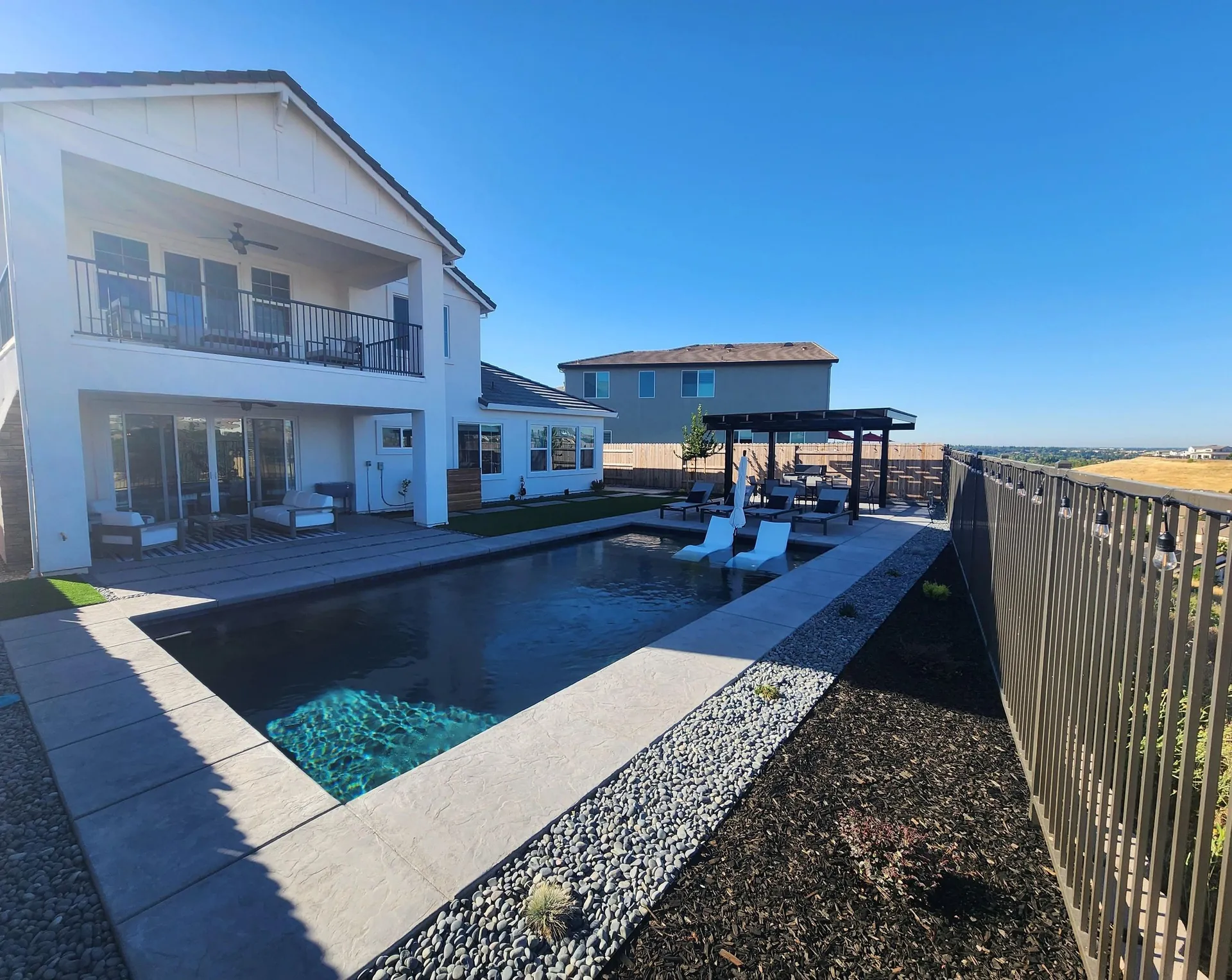
The defining constraint on a Sacramento-area backyard is that the prime entertaining hours in summer are often the most brutally hot. The trend with the most staying power is serious, built-in shade: solid-roof pergolas and pavilions, and increasingly motorized louvered roofs that tilt to block the high afternoon sun and open up for evening stars. Unlike a fabric umbrella, these create a genuinely usable room in 100-degree heat.
The better installations pair shade with cooling — misting lines, ceiling fans rated for outdoor use, and orientation that catches the Delta breeze that typically arrives in the evening. The point is to convert a patio that's unusable from noon to six in July into space the household actually lives in. That extension of usable hours is what makes the investment land, and why this is less a trend than a regional necessity.
Increasingly these structures are wired and plumbed as proper rooms from the start — recessed heaters and infrared elements to push the shoulder seasons into November and March, integrated lighting, and weatherproof power for a television or sound system. Building those services in during construction, rather than surface-mounting them later, is what separates a covered patio that gets used year-round from one that only works on perfect evenings.
Pools that read as water features, and cold plunges
Pools remain central to high-end Placer backyards, but the design language has shifted. The trend is away from the big blue rectangle and toward pools that work as water features even when no one's swimming — darker interior finishes that mirror the sky, clean geometric or naturalistic edges, integrated spas, and baja shelves for sitting half-submerged in the heat. The water becomes part of the view from the house, not just a recreation tank.
On the wellness side, cold plunges and compact spa-cold combinations have moved from gyms into private backyards, often tucked into a planted corner rather than dominating the space. Across both, the durable trend is integration: the pool, spa, deck, shade, and planting designed together so the water feature feels like it belongs to the landscape rather than being dropped into the middle of it.
The finish choices follow the same logic. Darker plaster and pebble interiors, large-format porcelain or natural-stone decking that stays cooler underfoot than poured concrete, and a flush transition between deck and water all push the pool toward looking like a designed body of water rather than a recreational appliance. These are the details that hold up visually for a decade-plus, which matters given what a pool costs to build in the first place.
Fire-conscious materials and defensible-space design
In the foothill communities — Loomis, Auburn, Granite Bay's eastern edge, El Dorado Hills, Cameron Park — wildfire risk has moved from an afterthought to a design driver. The trend among informed homeowners is toward landscapes that are beautiful and defensible at once: noncombustible hardscape and gravel zones close to the house, well-irrigated and well-spaced planting rather than continuous flammable masses, and careful choices about where trees and shrubs sit relative to structures.
This dovetails with material trends that were already moving that way for other reasons. Porcelain pavers, natural stone, steel, and concrete are favored both for their clean modern look and because they don't carry fire. Designing to defensible-space principles from the start — rather than retrofitting under an insurance deadline — is increasingly the mark of a serious foothill project, and one that can matter for insurability.
- Noncombustible zone of hardscape, DG, or gravel in the first five feet around the home
- Well-spaced, higher-moisture planting in place of dense, dry shrub masses
- Mature-tree and oak preservation balanced against clearance from structures
- Stone, porcelain, steel, and concrete favored over combustible surfaces near the house
Water-wise as the default, and outdoor kitchens that get used
What used to be the drought-year exception is now the regional baseline. High-end clients increasingly expect water-wise design from the outset — drip irrigation, smart controllers, Mediterranean and native planting, and lawn reduced to a deliberate panel. With MWELO governing permitted renovations and PCWA and SMUD periodically incentivizing turf replacement, the efficient design is also the compliant and cost-effective one. Far from a compromise, it's become the look serious properties want.
Outdoor kitchens, meanwhile, have matured from a token built-in grill to genuine cooking spaces — but the trend that matters is restraint about siting. The ones that get used are placed for the cook to face guests, shielded from afternoon sun and evening smoke drift, and lit for night use. The connecting thread across all of these trends is the same: in this climate, the features that endure are the ones designed around how we actually live outdoors here. If you're planning a project and want to separate the trends worth your money from the ones that won't age well, reach out for a site consultation.