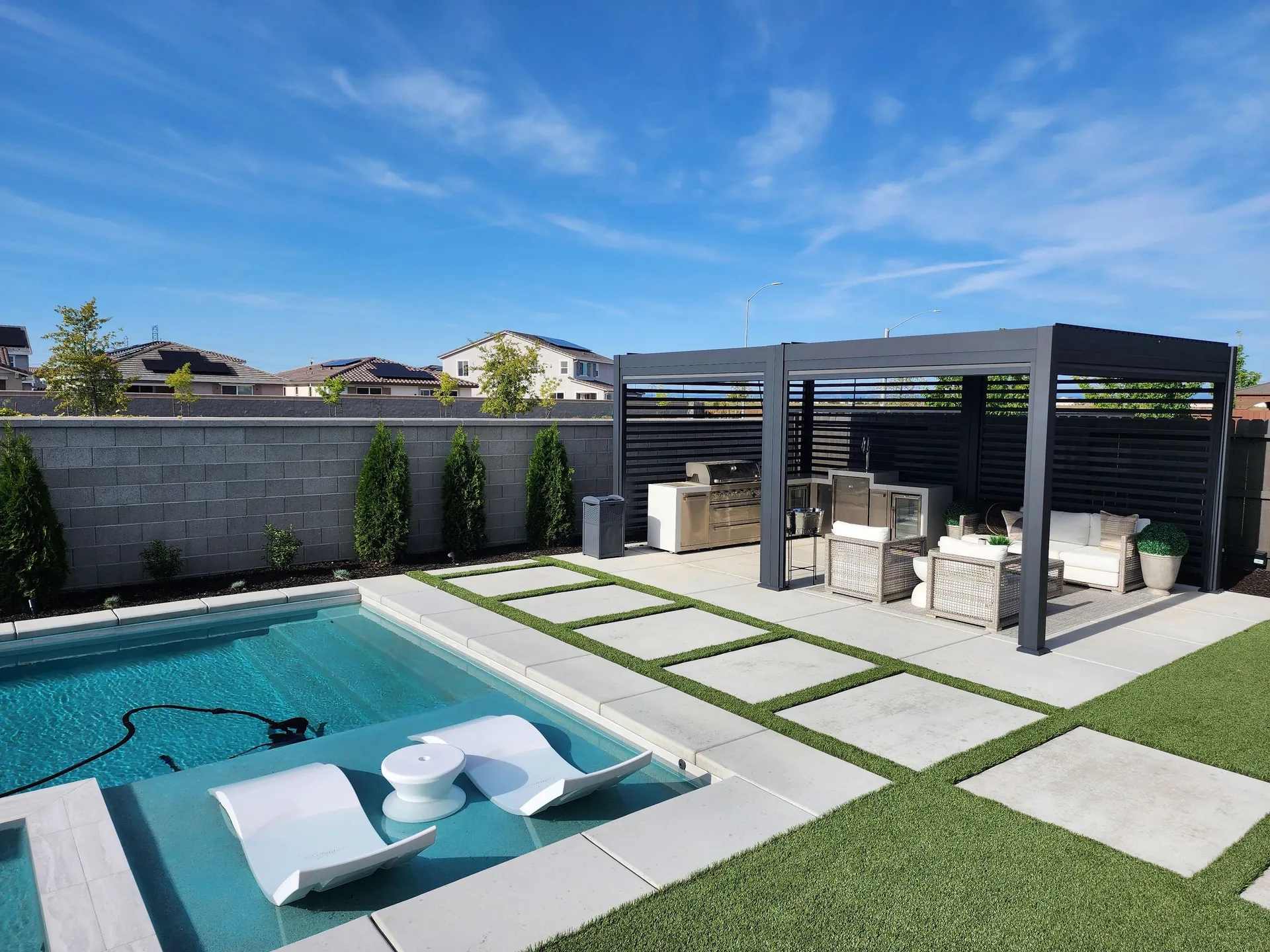
The Deck Is Built Below the Surface
Most homeowners choose pool decking from photos, which makes sense. It is the largest visible surface in the whole backyard, and it sets the tone for the pool. But the material on top is not what decides whether that deck still looks right in ten years. What decides it is everything underneath: the subgrade, the compacted aggregate base, the drainage, and how the deck is detailed where it meets the pool shell and the surrounding soil.
Across Roseville, Granite Bay, Rocklin, and much of the Sacramento Valley floor, we are usually building on expansive clay. It takes on water through the winter and swells, then dries and shrinks through a long summer. That annual cycle is what lifts and cracks a slab, or leaves a paver field wavy along the edges. In the foothills toward Loomis, Auburn, and El Dorado Hills you add rocky decomposed granite, steeper grades, and pockets of fill that were never engineered for a hard surface.
No decking material overcomes bad prep. Before we talk about looks, the base work has to be right.
- Strip unstable topsoil and organics rather than paving over them
- Compact the subgrade in lifts, then place and compact Class II aggregate base to the right thickness for the soil and use
- Slope the finished deck away from the pool and the house, typically about a quarter inch per foot
- Give water a defined exit: deck drains, channel drains at low points, and a solid outfall instead of a pipe that ends in a planter
Heat Underfoot Is the First Real Test
A pool deck in this region gets used barefoot on afternoons well over 100 degrees. Surface temperature is not a brand feature; it is a function of color and density. Light colors reflect more sunlight. Dense, dark materials absorb and hold heat, then release it into the evening.
Travertine is usually the coolest of the three. It is a light natural stone, and its porosity keeps it from storing heat the way a solid dark unit does. Light tan and buff concrete pavers come next and are comfortable for most people. Standard gray poured concrete runs warmer, and dark integral color or a deep stamped-and-stained finish will be the hottest surface in the yard by mid-afternoon.
Color choice is only half of it. Where the deck sits relative to afternoon sun matters just as much. A pergola over the lounge zone, a shade tree placed on the west side, or a cool-deck style coating on a concrete field can each take the edge off. The best fix is planning the traffic paths, from the door to the water and from the water to the seating, so people are not crossing a wide, unshaded expanse in August.
Slip Resistance and Edge Detailing
Wet feet on a sloped surface is the whole design problem. All three materials can be made safe, and all three can be made slick by the wrong finish or the wrong sealer.
Tumbled or brushed travertine has natural texture and performs well wet. Concrete pavers with a light surface texture do the same. Poured concrete depends entirely on the finish: a broom, salt, or knockdown texture grips, while a hard steel-troweled finish is genuinely dangerous around water. The most common mistake we get called to fix is a glossy topical sealer applied over an otherwise good deck. If you seal, use a matte penetrating sealer, or have an anti-slip additive mixed in.
Edges deserve the same attention. Coping should be bullnosed or eased so it is comfortable to sit on and grab. Where the deck meets a lawn, planter, or turf, a proper edge restraint keeps pavers and stone from creeping outward over the years.
How the Three Actually Compare
Set side by side on the same well-built base, here is where each material earns its place.
- Concrete pavers: modular units on compacted base and bedding sand. Strong, wide range of colors and textures, and the most forgiving over time because individual pavers lift and reset. Joints need sand maintenance. Mid-range cost.
- Poured concrete: the most economical way to cover a large area and the fastest to install. It will crack eventually, so the honest goal is controlling where, using proper thickness, reinforcement, and control joints cut on a sensible pattern. Stamping and coloring expand the look but raise both cost and surface heat.
- Travertine: natural stone, coolest underfoot, and the most refined appearance of the three. Higher material cost and more careful installation. It is porous, so it wants good drainage and a penetrating sealer, and softer pieces can chip under heavy impact.
- All three: performance depends more on base preparation, drainage, and slope than on which one you pick.
Water Chemistry, Movement, and the Long View
Saltwater systems are common here, and salt is hard on porous materials over time. Splash-out that sits and evaporates on unsealed stone or concrete leaves mineral deposits and can cause surface pitting on the lowest-quality units. A quality penetrating sealer and a deck that sheds water instead of ponding solve most of it.
In the foothills, where Auburn, Cameron Park, and the higher parts of El Dorado Hills see real frost, saturated porous stone is the failure mode to plan around. Water that soaks in, freezes, and expands is what spalls a surface. Again, the answer is drainage, not a different material.
Repairability is where the three separate most clearly over a decade. A settled area of paver deck is lifted, the base is corrected, and the same units go back down, with no visible patch. Travertine set correctly can be replaced piece by piece. A cracked concrete slab is patched, resurfaced, or saw-cut and replaced in sections, and the repair usually shows. That difference is worth weighing if your yard has known soil movement or if utility lines run beneath the deck.
Choosing What Fits Your Yard
There is no single right answer. A large, simple deck on stable soil with a tight budget is a good candidate for well-detailed poured concrete. A yard with clay movement, phased plans, or lines running under the deck favors pavers. A homeowner who wants the coolest, most finished surface and has the budget for it should look hard at travertine.
What does not change is the work below the surface. Compaction, base depth, slope, and drainage are what separate a deck that still sits flat in fifteen years from one that needs attention in three. Any contractor should be able to tell you exactly what they are putting under your deck and where the water goes.
If you are planning a new pool surround or replacing a deck that has started to move, we are happy to walk the yard with you, look at the soil and drainage, and lay out honest options. Reach out to request a consultation and we will take it from there.