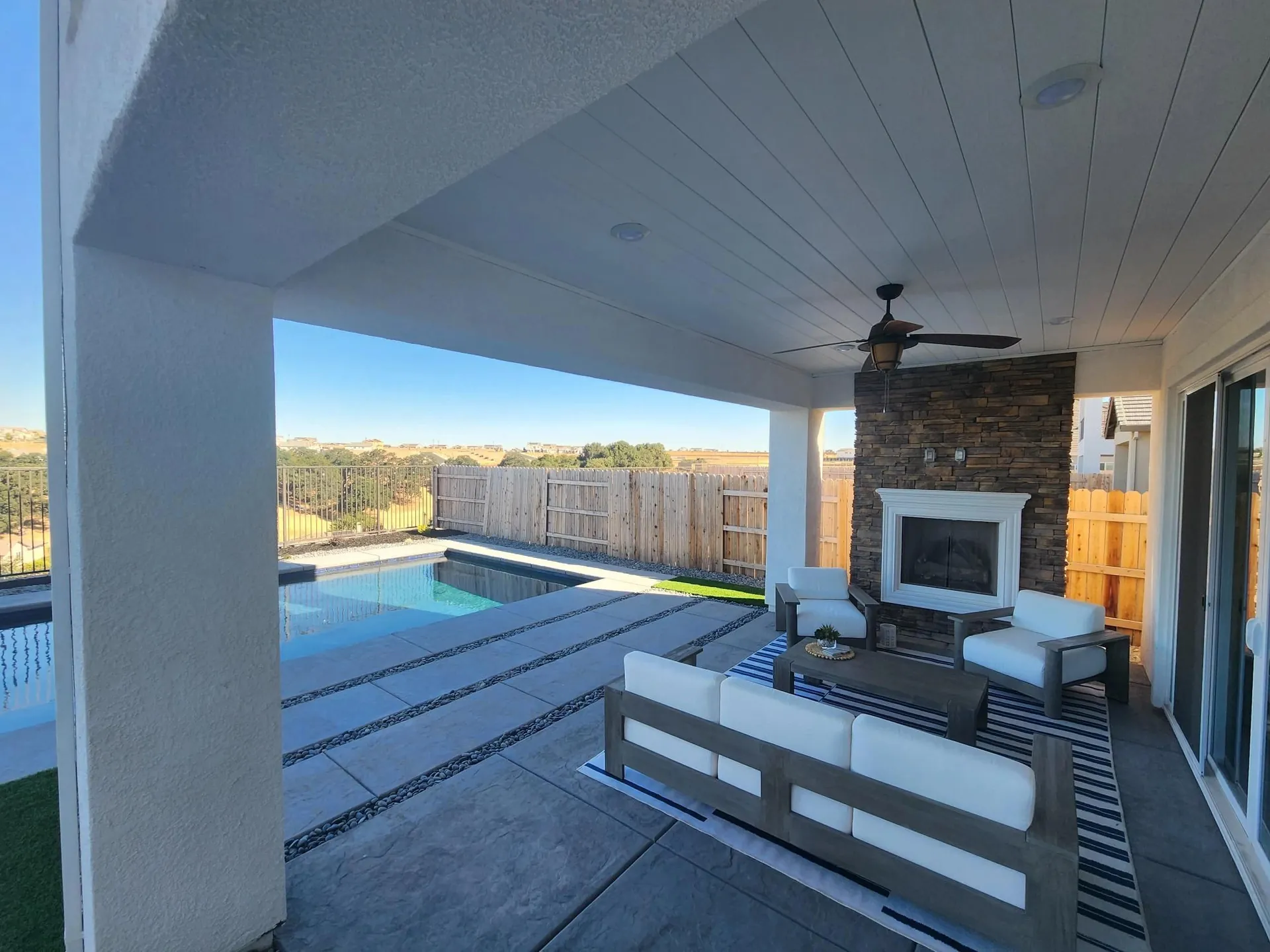
The resort feeling is a set of principles, not a shopping list
Ask most people what makes a backyard feel like a resort and they will name objects: a pool, an outdoor kitchen, a fire pit. But plenty of yards have all three and still feel like a hardware store parking lot. What a genuine resort delivers is not a quantity of features. It is a quality of experience, the sense of being somewhere set apart, calm, and complete, where everything belongs together.
That experience comes from a handful of design principles that hold true whether the yard is a quarter-acre in Roseville or several acres in Loomis. Privacy and enclosure. Layered planting that surrounds rather than decorates. Sensory detail in sound, light, and texture. And a cohesive material language so the whole space reads as one place. Get those right and even a small yard feels like a retreat. Get them wrong and no amount of expensive equipment will.
Below is the blueprint, principle by principle, with the regional specifics that make it work in the Sacramento and Placer climate.
Privacy and enclosure: the precondition for everything else
A resort never feels exposed. The first thing that separates a retreat from a backyard is that you cannot see, or be seen by, the neighbors and the street, and you are not staring at a bare fence line. Until that sense of enclosure exists, no feature inside the yard will feel private, and privacy is the precondition for relaxation.
Achieving it in our area is usually a layered job rather than a single tall fence. Evergreen screening that holds its leaves year-round is the backbone, and reliable choices for the Sacramento and Placer climate include columnar evergreens and clumping (non-invasive) screening grasses for tight spaces, plus broadleaf evergreens for fuller coverage; these keep the screen working through winter when deciduous plants drop. Layered against a fence, a wall, or a pergola section, planting softens the boundary so it reads as a garden edge instead of a property line.
On foothill lots in Granite Bay, Loomis, and the El Dorado area, screening also has to respect fire-wise spacing, leaving defensible clearance and favoring higher-moisture, lower-resin plants near structures rather than dense, oily evergreens packed against the house.
Layered planting that surrounds you
Resort landscapes immerse you in green; ordinary yards line plants up along the fence like a border. The difference is layering, canopy trees overhead, mid-height shrubs and ornamental grasses at eye level, and low groundcover and perennials beneath, arranged so greenery wraps the usable spaces rather than ringing the perimeter.
In our climate this can be done beautifully while staying water-wise, which matters both for cost and for California's water rules (the state's MWELO landscape efficiency standards apply to many larger and permitted projects). A Mediterranean and California-friendly palette, think olive, manzanita, rosemary, lavender, ornamental grasses, agave and other structural succulents, grouped into hydrozones and irrigated by drip on a smart controller, delivers lush layers on a fraction of the water a traditional planting would demand.
The resort trick is generosity in the right places: a few large specimens and full, mature-looking masses near where people sit, rather than many small plants scattered thinly. Density where it is experienced, restraint where it is not.
Engineer the senses: sound, light, and temperature
Resorts are designed for the senses, and three in particular do the heavy lifting. Sound is first. Moving water, a pondless spillover, a spa with a spillway, a simple scupper, masks street and neighbor noise and is the single most effective way to make a yard feel removed from the world around it. Pondless and recirculating designs are the water-wise way to get that effect in a drought-conscious region.
Light is second. After dark is when a resort feels most like a resort, and layered low-voltage LED lighting, uplit trees, grazed walls, glowing steps and paths, a soft wash on the water, is what carries the feeling into the evening. The goal is focal points and shadow, not floodlit brightness. Because Sacramento evenings stay warm long after sunset, this is also when the yard gets the most use.
Temperature is third. Shade, from pergolas, patio covers, and canopy trees, makes the space usable through 100-degree afternoons, while a fire feature or heaters reclaim the cool evenings and the shoulder seasons. A yard that is comfortable across the day and the year is one that actually delivers the escape it promises.
- Water for sound: a pondless or recirculating feature to mask the neighborhood.
- Layered LED lighting for depth after dark, focal points over floodlighting.
- Shade plus a fire feature so the space works at noon and at night.
- A water-wise, hydrozoned planting palette suited to Placer and Sacramento.
Cohesion, and the build quality that holds it together
The final principle is the one that ties the rest into a resort rather than a collection: cohesion. A limited, repeated palette of materials, the same stone or paver running through the deck, the kitchen base, and the fire feature, a consistent lighting tone, and planting that carries from zone to zone, is what makes a yard read as a single designed place. Mixing too many materials and styles is the fastest way to make even an expensive backyard feel busy and unresolved.
Cohesion also depends on what is underground. The grading that sheds winter water, the compacted base beneath every paved surface, the drainage that keeps the lower zones from flooding, and the efficient irrigation that keeps the planting alive through summer and within water rules, these are what let the visible design stay intact for years. A resort that develops puddles, cracks, and dead plant masses stops feeling like a resort fast.
If you want a backyard that feels like a private retreat rather than a set of separate features, anywhere across Roseville, Granite Bay, Loomis, Folsom, El Dorado Hills, and the greater Sacramento and Placer area, share your site photos, any HOA design guidelines, and a budget range. We will help shape the principles into a plan built to hold its character over time.